
A dental implant can serve you for many years, but it still needs regular check-ups. It does not develop tooth decay, but the gum and bone around it can become inflamed. You may not feel any pain, even when a problem is already developing. That is why it is important to understand what peri-implantitis is and which signs should not be ignored.
Many people think that once an implant has been placed, the problem of a missing tooth is solved forever. An implant can indeed be a very durable solution, but only if it is properly cleaned and regularly monitored. It is not a natural tooth. It cannot get cavities, but the tissues around it can still become diseased.
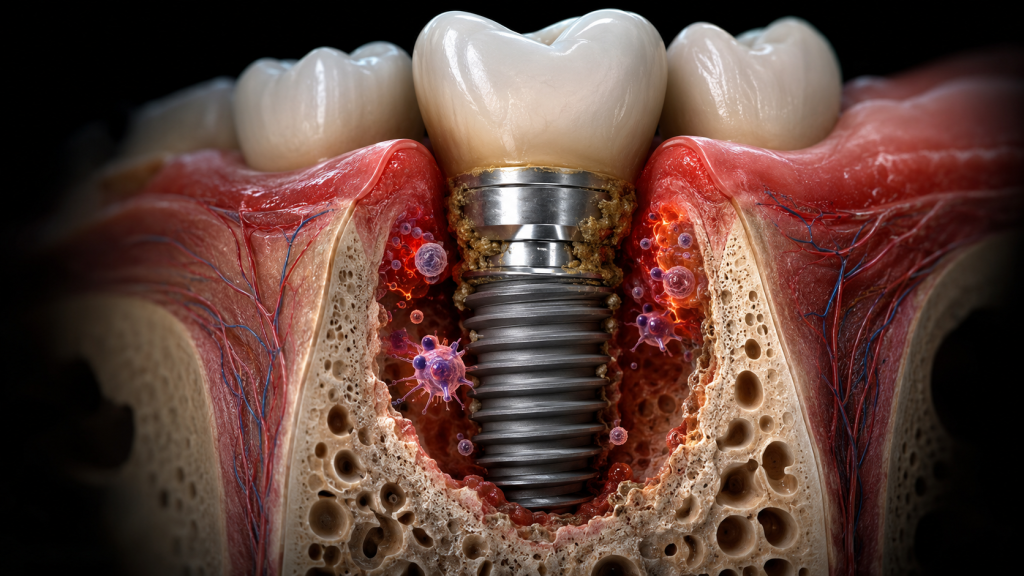
The problem often begins with bacteria that collect around the implant, crown, bridge, or in places that are difficult to clean. These bacteria form a thin layer called biofilm. You may not see it, but your gum can react to it with inflammation.
At first, inflammation may affect only the gum around the implant. You may notice bleeding when brushing, swelling, redness, tenderness, or difficulty cleaning the area properly. At this early stage, the problem can often be stopped, especially if you see your dentist or dental hygienist early and improve your daily cleaning routine.
The situation becomes more serious when inflammation starts to affect the bone around the implant. This is called peri-implantitis. It is not just simple gum irritation. It is a disease of the tissues around the implant that can lead to gradual bone loss. Bone is essential for the implant because it keeps it stable.
The difficult part is that peri-implantitis often does not hurt at the beginning. You may feel that everything is fine, while the only sign may be slight bleeding or an unpleasant smell. This is why you should not wait for pain when you have an implant. Pain may appear late, when the problem is already more advanced.
Bleeding around an implant does not always mean a serious disease, but it is always a signal worth checking. It may appear when brushing, flossing, using an interdental brush, or during a dental examination. You should not stop cleaning the area only because it bleeds. It is better to have it checked and find out what is causing the problem.
The risk of peri-implantitis is not linked only to oral hygiene. Smoking, diabetes, previous gum disease, difficulty cleaning around the implant, bite overload, and lack of regular check-ups may also play a role. This is why your dentist assesses not only the implant itself, but also the gum, bone, cleaning habits, general health, and your individual risk factors.
During a check-up, your dentist or dental hygienist checks whether there is bleeding, swelling, discharge, deeper pockets, or bone loss visible on an X-ray. This helps detect problems earlier, before they become more difficult to treat.
When should you see a dentist?
Book a check-up if you notice bleeding around the implant, swelling, redness, an unpleasant smell, discharge, pain, difficulty cleaning the area, or a change in the appearance of the gum. Do not wait until the implant starts to hurt or move.
Not every sign means a serious problem, but every sign is worth checking early. The sooner you react, the greater the chance that treatment will be simpler.
PATIENT REMINDER
- An implant cannot get tooth decay, but the gum and bone around it can become diseased.
- Bleeding around an implant is not normal — it is a signal to book a check-up.
- No pain does not always mean that everything is fine. Regular check-ups and daily cleaning are the best way to protect your implant for years.