
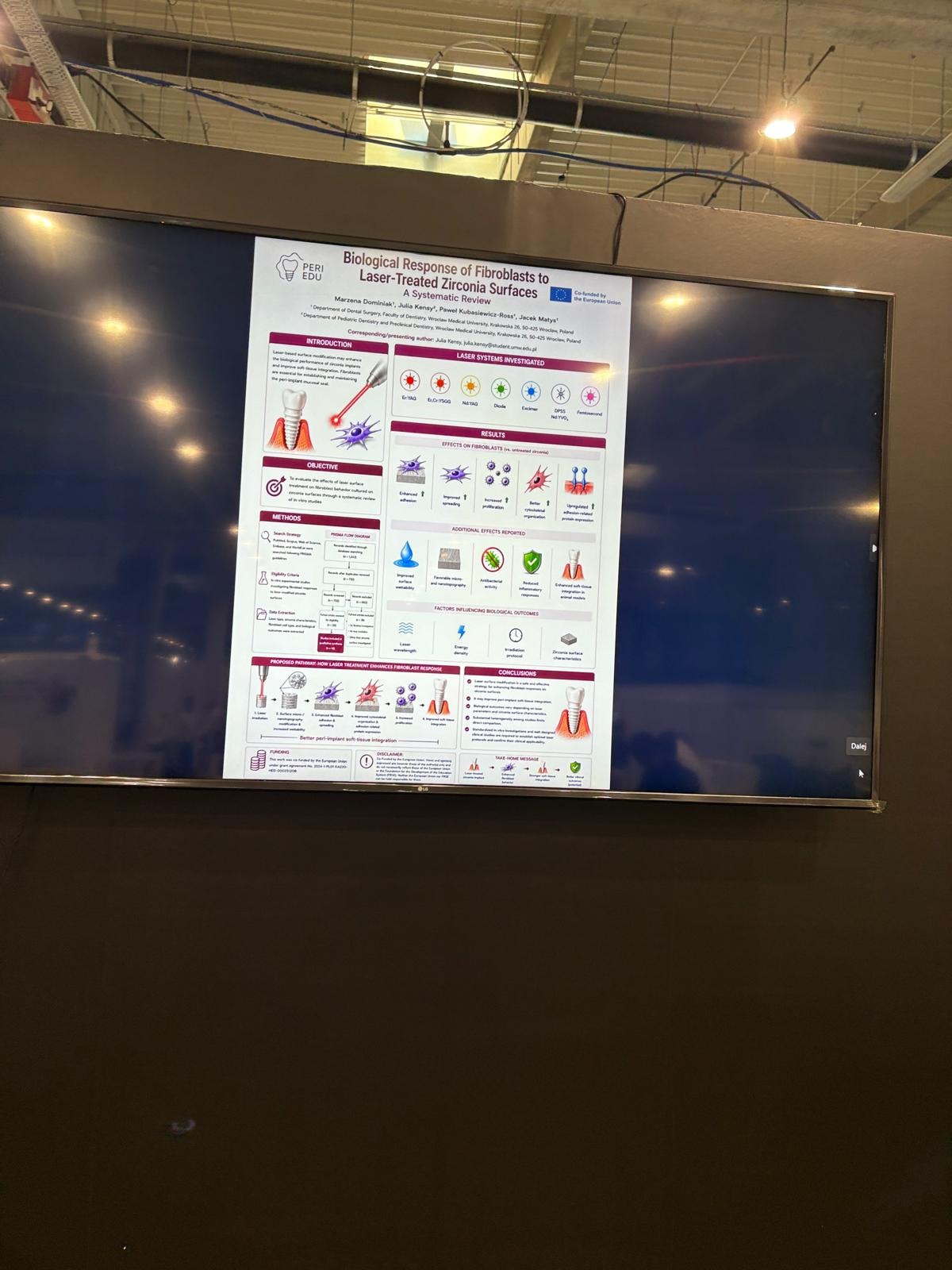
Biological Response of Fibroblasts to Laser-Treated Zirconia Surfaces was presented as part of the PERI-EDU research programme during the 9th Congress of the Polish Dental Association at Ptak Warsaw Expo.
Research question
Study design
Following PRISMA, the authors searched PubMed, Scopus, Web of Science, Embase and WorldCat for in-vitro studies of fibroblasts cultured on laser-modified zirconia. The review considered multiple systems, including Er:YAG, Er,Cr:YSGG, Nd:YAG, diode, excimer, femtosecond and related solid-state lasers.
Main findings
- Compared with untreated zirconia, laser-treated surfaces were associated with better adhesion, spreading, proliferation and cytoskeletal organization.
- Several studies reported increased adhesion-related protein expression and improved surface wettability.
- Additional observations included favourable micro- and nanotopography, antibacterial activity and encouraging soft-tissue responses in animal models.
- Outcomes varied with laser wavelength, energy density, irradiation protocol and the initial zirconia surface.
Interpretation
Laser treatment is a promising method for modifying zirconia without adding a separate coating. However, substantial experimental heterogeneity prevents identification of one optimal clinical protocol; standardized in-vitro and clinical studies are still required.
Download the full conference poster
The complete poster is available as a PDF, including figures, numerical results and the selected reference list.
Download poster PDF
View congress report
View abstract supplement
Funding: This work was co-funded by the European Union under grant agreement No. 2024-1-PL01-KA220-HED-000251208.
Disclaimer: Co-funded by the European Union. Views and opinions expressed are, however, those of the author(s) only and do not necessarily reflect those of the European Union or the Foundation for the Development of the Education System (FRSE). Neither the European Union nor FRSE can be held responsible for them.