
Successful treatment of peri-implantitis is not defined by a single instrument, laser wavelength or grafting material. It requires control of the biofilm-associated lesion, correction of accessible local drivers, appropriate surface decontamination and a surgical strategy matched to defect anatomy and treatment goals.
Treatment begins with diagnosis and cause control
Before choosing a procedure, the clinician should confirm the diagnosis, describe the extent and pattern of bone loss, assess implant position and mobility, identify prosthetic or cement-related factors and evaluate whether the patient can maintain the implant after treatment. An implant with loss of osseointegration, severe unfavourable positioning or an unmanageable prosthetic design may have a poor prognosis even when inflammation can be temporarily reduced.
Non-surgical therapy establishes the foundation
Initial therapy aims to reduce the microbial burden and improve access for daily plaque control. It may include oral-hygiene instruction, professional instrumentation, modification or removal of an overcontoured restoration, management of excess cement and treatment of periodontal inflammation at teeth. Non-surgical care is also a diagnostic phase: the response helps reveal whether inflammation can be controlled without surgical access.
Implant geometry and surface roughness make complete decontamination difficult. Consequently, non-surgical treatment often improves bleeding and probing findings but may be insufficient in advanced lesions.
Laser therapy: mechanism before device selection
Lasers may support removal or disruption of microbial deposits, treatment of inflamed soft tissue and decontamination of an exposed implant surface. Their clinical effect depends on wavelength, pulse characteristics, energy, water cooling, angulation, distance, exposure time and the optical and thermal properties of the target.
- Er:YAG and Er,Cr:YSGG systems interact strongly with water and can assist debridement of mineralised deposits and implant surfaces when appropriate parameters and cooling are used.
- Diode lasers interact primarily with pigmented tissues and may be used for soft-tissue applications or photodynamic protocols; direct contact with an implant surface requires careful thermal control.
- Antimicrobial photodynamic therapy combines a photosensitiser with light to generate reactive species. It is an adjunct and does not correct defect morphology or prosthetic risk factors.
Surgical access and defect-oriented treatment
| Clinical situation | Possible direction | Main purpose |
|---|---|---|
| Persistent inflammation with inaccessible contaminated surface | Access-flap surgery with debridement and surface treatment. | Improve visibility and access for decontamination. |
| Predominantly supracrestal or non-contained defect | Resective or combined approach, sometimes including implantoplasty in selected areas. | Reduce the residual pocket and create maintainable anatomy. |
| Contained intrabony defect with regenerative potential | Regenerative or combined surgery using an appropriate grafting strategy. | Support defect fill while controlling the inflammatory lesion. |
| Implant mobility, extreme bone loss or non-maintainable positioning | Consider explantation and staged rehabilitation. | Avoid repeated treatment of a non-salvageable implant. |
Outcome assessment
Treatment success should be judged through resolution or substantial reduction of inflammation, absence of suppuration, reduction in pathological probing depths, radiographic stability and the patient’s ability to maintain the site. Long-term supportive peri-implant care is essential because recurrence remains possible after both non-surgical and surgical therapy.
Recorded conference lecture
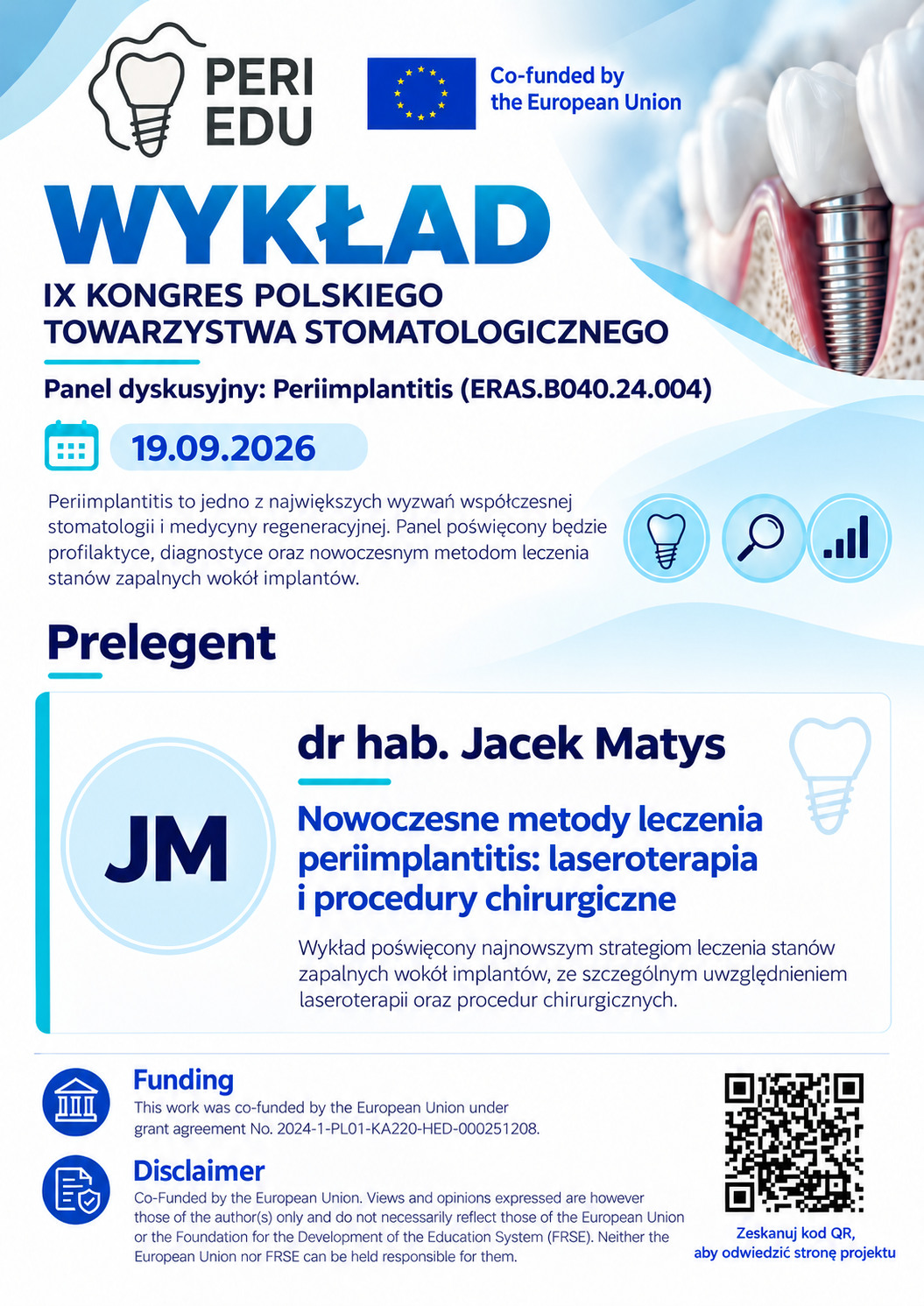
In this PERI-EDU lecture, Jacek Matys, DMD, PhD, DSc, discusses modern peri-implantitis treatment with particular emphasis on laser-assisted therapy and surgical procedures.
Disclaimer: Co-funded by the European Union. Views and opinions expressed are those of the author(s) only and do not necessarily reflect those of the European Union or the Foundation for the Development of the Education System (FRSE). Neither the European Union nor FRSE can be held responsible for them.