
Complete blood count-derived inflammatory indices combine routine neutrophil, lymphocyte, monocyte and platelet counts into ratios or composite measures. They may describe a patient’s systemic inflammatory background, but they do not identify the anatomical source of inflammation and cannot diagnose peri-implantitis.
What the indices represent
Circulating leukocytes and platelets participate in immune defence, inflammatory signalling and tissue repair. Combining their counts can amplify patterns that may be less evident when each cell type is viewed separately. These measures are inexpensive and easy to calculate, which makes them attractive for observational research.
| Index | Calculation | General interpretation |
|---|---|---|
| NLR | Neutrophils ÷ lymphocytes | Balance between innate inflammatory activity and lymphocyte-related immune regulation. |
| PLR | Platelets ÷ lymphocytes | Platelet-associated inflammatory and vascular context relative to lymphocytes. |
| MLR | Monocytes ÷ lymphocytes | Monocyte-related inflammatory activity relative to lymphocyte count. |
| SII | Platelets × neutrophils ÷ lymphocytes | Composite measure integrating three circulating cell populations. |
| SIRI | Neutrophils × monocytes ÷ lymphocytes | Composite measure of neutrophil- and monocyte-related systemic inflammation. |
| AISI / PIV | Neutrophils × monocytes × platelets ÷ lymphocytes | Higher-order composite index; terminology and reporting conventions must be stated clearly. |
Why interpretation requires caution
These indices are non-specific. Age, obesity, smoking, diabetes, cardiovascular disease, acute infection, malignancy, medication, physiological stress and the timing of blood collection may influence cell counts. A high value therefore cannot be assigned to peri-implant inflammation without considering the complete medical and clinical context.
Published cut-off values are population- and outcome-dependent. Differences in study design, laboratory methods, disease definitions and adjustment for confounders make it inappropriate to transfer one threshold directly into routine implant practice.
Local diagnosis remains primary
Peri-implantitis is diagnosed through clinical evidence of inflammation together with progressive loss of supporting bone. The core assessment includes bleeding on probing, suppuration, probing depth and its change from baseline, the mucosal margin, plaque-retentive factors and radiographic bone levels. Blood-derived indices cannot replace these findings.
A responsible interpretation sequence
- Confirm that the blood count is technically valid and review the absolute cell counts.
- Check for acute infection, medication effects, smoking and relevant systemic conditions.
- Calculate indices using explicitly reported formulas and consistent units.
- Interpret the result against an appropriate reference population, not a universal cut-off.
- Keep local peri-implant diagnosis separate from systemic inflammatory context.
- In research, adjust analyses for major confounders and avoid causal conclusions from cross-sectional associations.
Recorded conference lecture
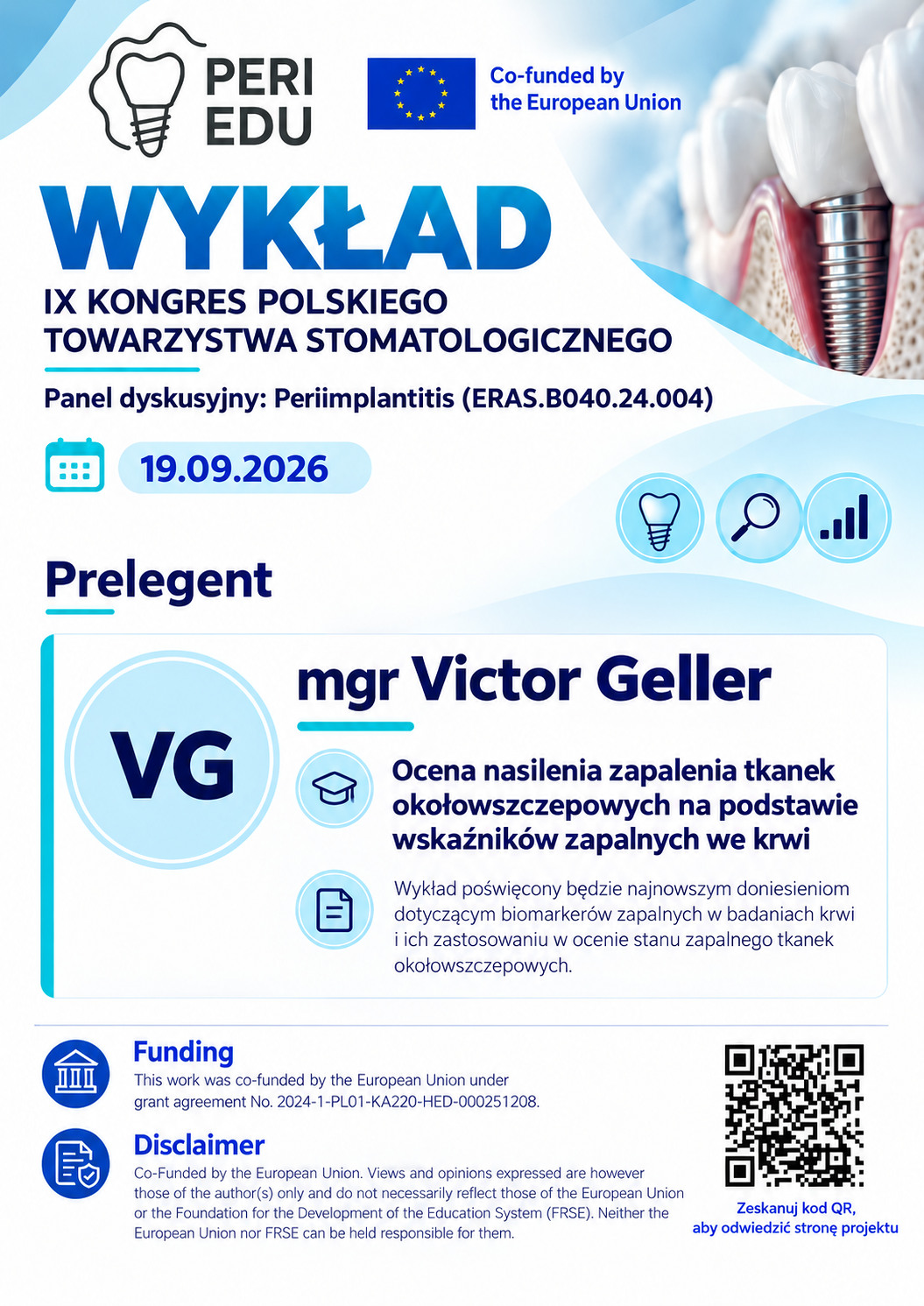
In this PERI-EDU lecture, Victor Geller, MSc, biotechnologist, presents current concepts concerning inflammatory biomarkers in blood and their use in assessing inflammation associated with peri-implant tissues.
Disclaimer: Co-funded by the European Union. Views and opinions expressed are those of the author(s) only and do not necessarily reflect those of the European Union or the Foundation for the Development of the Education System (FRSE). Neither the European Union nor FRSE can be held responsible for them.