
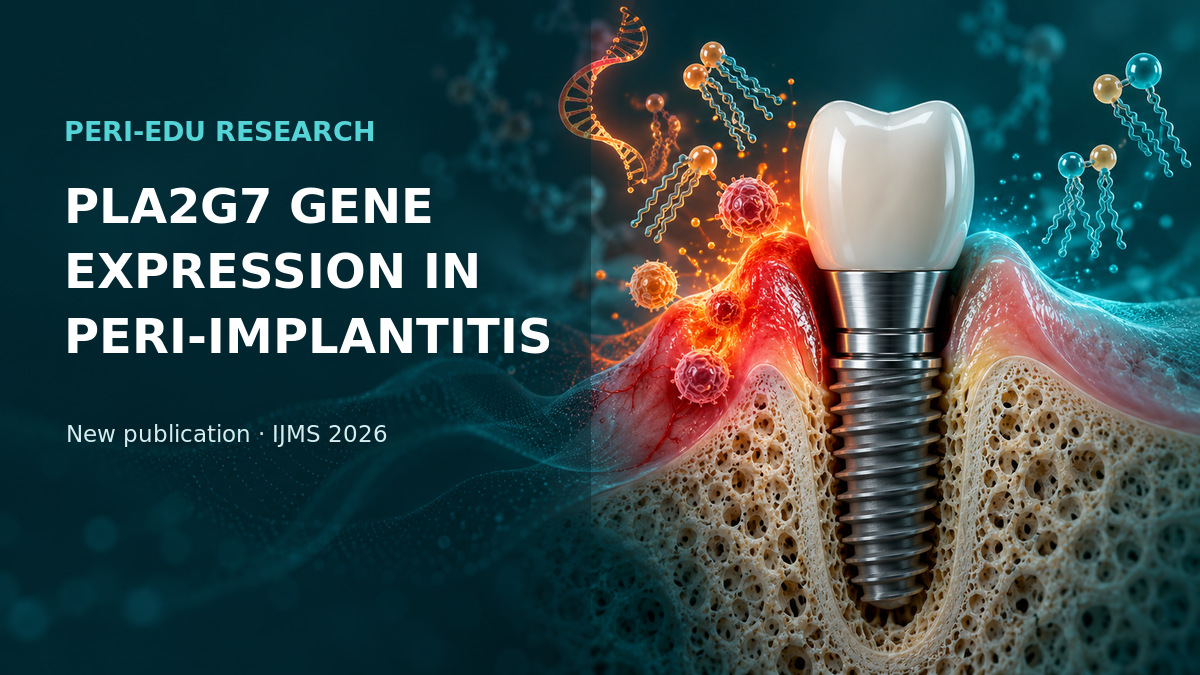
A new PERI-EDU publication investigates whether selected phospholipase A2 genes show different expression in inflamed peri-implant tissue and clinically non-inflamed gingiva from the same patient. The study provides preliminary molecular evidence that the PLA2 response in advanced peri-implantitis may be selective rather than uniform.
Why phospholipase A2 signalling matters
Phospholipase A2 enzymes participate in lipid-mediated inflammatory signalling by releasing fatty acids and lysophospholipids from cell membranes. These pathways can influence immune activation, tissue destruction and bone remodelling. Because peri-implantitis combines chronic inflammation with progressive loss of supporting bone, genes involved in these pathways are relevant candidates for molecular investigation.
The study focused on four genes representing different parts of the phospholipase A2 family: PLA2G7, PLA2G4A, PLA2G6 and PLA2G12A. Rather than assuming that the entire enzyme family behaves in the same way, the researchers tested each target separately.
Paired tissue comparison within the same patient
19 patients
The cohort included patients with active, advanced peri-implantitis requiring implant explantation.
Two local samples
Inflamed peri-implant tissue was compared with clinically non-inflamed reference gingiva adjacent to the same implant.
qRT-PCR analysis
Gene expression was quantified for four PLA2 targets and normalised to GAPDH.
This intra-individual approach reduces variability caused by differences between patients. Factors such as age, systemic health, medication use and genetic background are shared by both samples from the same participant, allowing the analysis to focus more closely on local tissue status.
A selective increase in PLA2G7 expression
PLA2G7 was the only investigated gene with a statistically significant paired increase in inflamed peri-implant tissue. Its median expression was 5.86-fold higher than in the local reference tissue. By contrast, PLA2G4A, PLA2G6 and PLA2G12A did not show statistically significant paired differences after adjustment for multiple comparisons.
The findings point to a targeted molecular pattern rather than a general activation of all examined PLA2 genes. PLA2G7 may therefore be relevant to the inflammatory and bone-resorptive environment of advanced peri-implantitis, but its biological and diagnostic significance still requires confirmation.
What comes next?
Future research should combine transcript measurements with PLA2G7 protein concentration, enzyme activity and lipidomic profiling. Larger cohorts, different stages of peri-implant disease and longitudinal observations will be needed to determine whether PLA2G7 can contribute to patient stratification, disease monitoring or the development of targeted therapies.
The publication strengthens PERI-EDU’s research programme by connecting clinical peri-implant disease with molecular mechanisms that may help explain why inflammatory destruction progresses differently among patients.
Read the open-access article
Baranowska A, Dominiak M, Matys J, Hadzik J, Gedrange T, Kulbacka J, et al. Selective Phospholipase A2 Gene Expression in Peri-Implantitis: An Intra-Individual Paired Gingival Tissue Study. International Journal of Molecular Sciences. 2026;27:8717. doi:10.3390/ijms27198717.
Funding: The research was supported by the PERI-EDU project, Erasmus+ KA220-HED, grant no. 2024-1-PL01-KA220-HED-000251208. The project is co-funded by the European Union. The views and opinions expressed are those of the authors and do not necessarily reflect those of the European Union or the funding authority.