
Peri-implant disease prevention begins before inflammation is detected. It combines patient-level risk control, prosthetic cleansability, systematic maintenance and reproducible baseline documentation. Early diagnosis then depends on recognising change over time rather than interpreting one isolated measurement.
Prevention is a structured clinical process
Peri-implant mucositis is characterised by inflammation confined to the soft tissues around an implant, whereas peri-implantitis combines mucosal inflammation with progressive loss of supporting bone. Prevention therefore has two complementary aims: limiting the development of inflammation and detecting reversible disease before structural support is lost.
| Preventive domain | Clinical focus | Why it matters |
|---|---|---|
| Patient preparation | Periodontal stability, smoking, glycaemic control, hygiene capacity and attendance. | Reduces modifiable biological and behavioural risk. |
| Implant and prosthetic planning | Three-dimensional implant position, tissue conditions, emergence profile and access for cleaning. | Creates an environment that can be examined and maintained. |
| Baseline documentation | Probing depth, bleeding and suppuration, mucosal margin, radiograph and prosthetic condition. | Provides the reference needed to recognise later change. |
| Supportive care | Individual recall interval, professional biofilm control, reinforcement of home care and repeated risk review. | Prevention is longitudinal, not a single postoperative instruction. |
Baseline findings create the diagnostic reference
A peri-implant examination should be documented after the prosthesis has been delivered and tissue conditions have stabilised. Gentle probing is appropriate and provides clinically useful information. Probing depth must be interpreted together with bleeding on probing, suppuration, recession or changes in the mucosal margin, prosthetic access and radiographic bone levels.
Without a baseline, a deep peri-implant sulcus may be difficult to distinguish from a pathological pocket. Similarly, a radiographic bone level can reflect early remodelling, implant position or disease. Serial comparison is more informative than a single image.
Early diagnostic workflow
- Identify inflammation: record bleeding on probing, suppuration, erythema, swelling and patient-reported symptoms.
- Compare probing findings: assess whether probing depths or the mucosal margin have changed from baseline.
- Evaluate plaque-retentive factors: inspect prosthetic contours, excess cement, component fit and access for cleaning.
- Assess bone levels when indicated: obtain a standardised intraoral radiograph when clinical findings suggest disease progression.
- Differentiate conditions: distinguish peri-implant mucositis from peri-implantitis and consider alternative causes of symptoms or bone loss.
- Act and reassess: control local inflammation, modify accessible risk factors and confirm the response at a defined review visit.
Recorded conference lecture
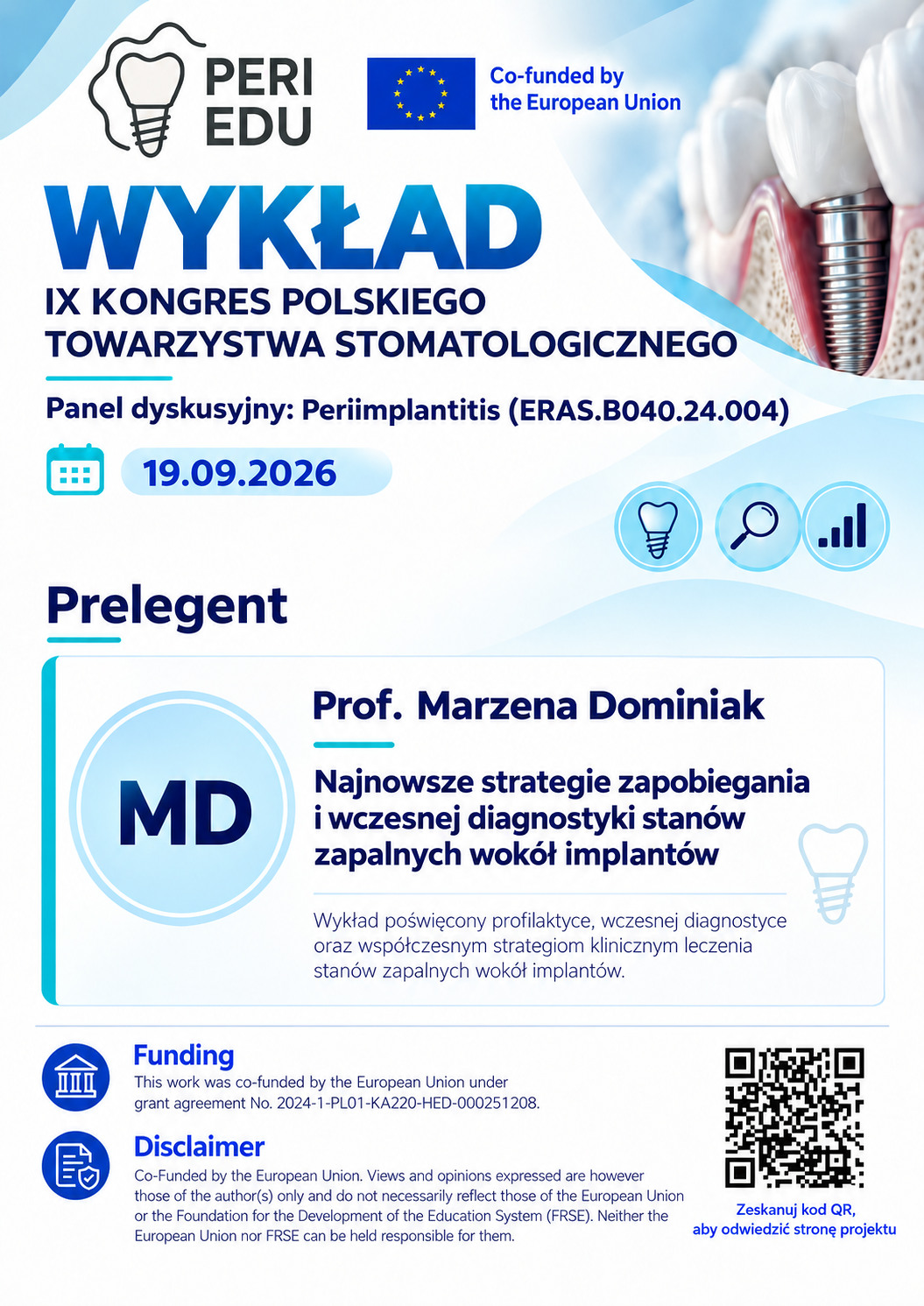
In this PERI-EDU lecture, Prof. Marzena Dominiak discusses contemporary strategies for preventing peri-implant inflammation and detecting disease at an early stage.
Disclaimer: Co-funded by the European Union. Views and opinions expressed are those of the author(s) only and do not necessarily reflect those of the European Union or the Foundation for the Development of the Education System (FRSE). Neither the European Union nor FRSE can be held responsible for them.